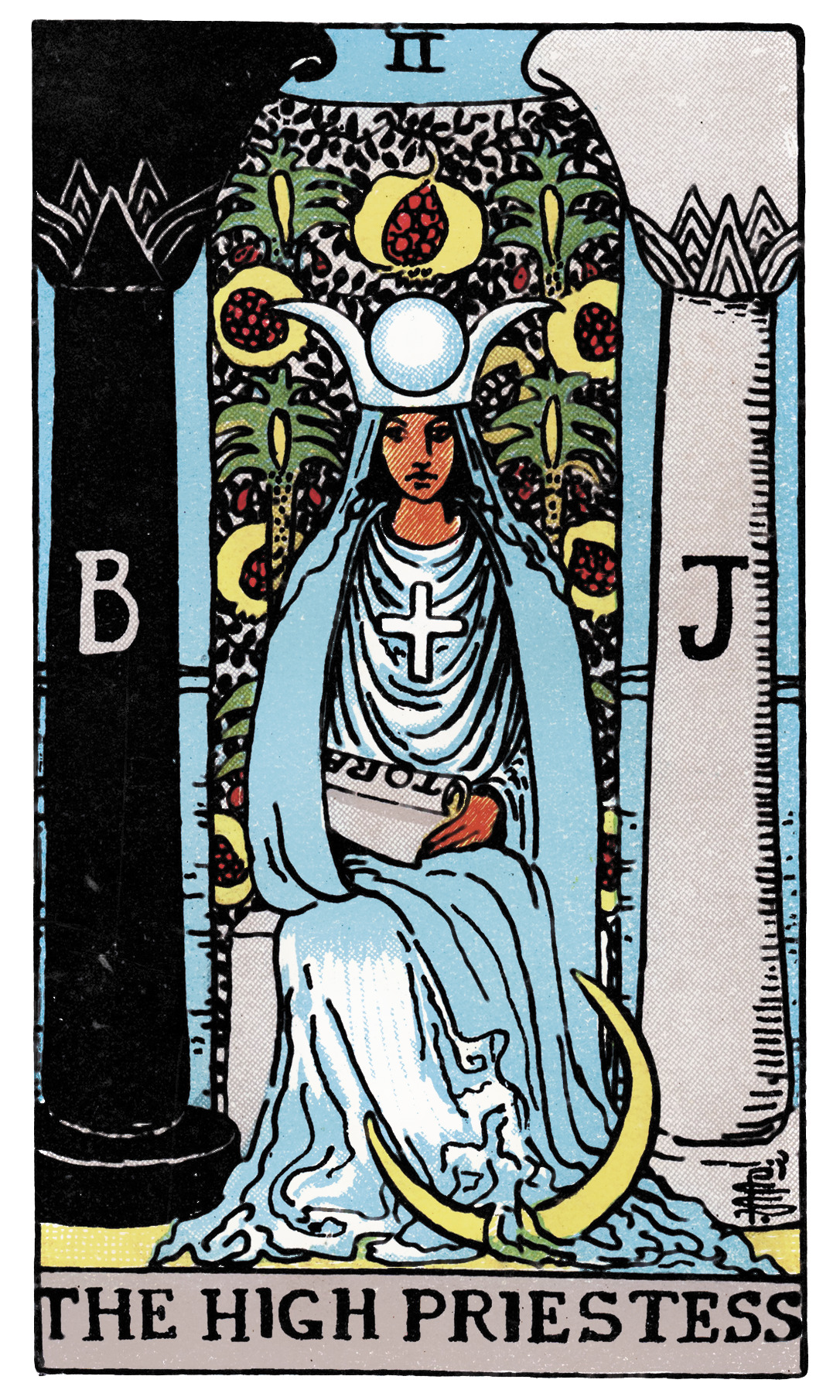
You don't have to believe in psychic powers to learn tarot. Plenty of people who read cards regularly — therapists, writers, designers, and a good number of self-described skeptics — don't think the cards know anything at all. What they've found is that a deck of 78 richly illustrated cards is an unusually good tool for noticing what you already think. If you've been curious about tarot but put off by the mystical sales pitch, this is a way in that doesn't ask you to suspend your judgment.
The cards don't know anything — and that's fine
Let's be direct: a shuffled deck has no access to your future, and nothing in a reading requires you to believe otherwise. The cards are printed paper, and the draw is random. What a reading does give you is a random prompt — a Tower, a Two of Cups, a Knight of Swords — and an invitation to respond to it. The meaning doesn't arrive from outside. It's built in the moment between the image and your own mind.
That might sound like it makes tarot less valuable, but it's the same principle behind a Rorschach inkblot, a journaling prompt, or a writer's deck of random story starters. A good prompt doesn't need to be magic. It just needs to get you thinking about something you might otherwise avoid.
Why a random card can still feel uncannily right
Skeptics usually raise the same few points, and they're worth taking seriously because they explain a lot of what's actually happening:
- Pattern-seeking. Human brains are built to find meaning in ambiguous images. Tarot art is deliberately symbolic and open-ended — a figure looking away from a row of cups can read as regret, relief, or restlessness depending on who's looking.
- Projection. When you decide a card "means" something, you're usually pulling that meaning from your own current worries and hopes. The card is the screen; you're the projector.
- The Barnum effect. Broad, flattering statements feel personal even when they apply to nearly everyone. Tarot's traditional meanings are intentionally general, which is part of why they fit so often.
- Confirmation bias. We remember the readings that landed and forget the ones that didn't.
Knowing all this doesn't ruin tarot. It makes you a better reader, because you stop treating a card as a verdict and start treating it as a question.
Where your intuition actually comes in
"Intuition" doesn't have to mean a mystical sixth sense. In practice, it's the fast, below-the-surface judgment your mind forms from everything you've experienced — things you've noticed but haven't put into words. You often know that a situation at work is off, or that you're more anxious about a decision than you've admitted, before you can say why.
Tarot gives that quiet knowledge somewhere to land. When you look at a card and your first reaction is a flicker of unease, or relief, or irritation, that reaction is real information about you. A skeptical reader pays attention to it without needing to credit the deck. The question stops being "what does the card say will happen?" and becomes "why did this image hit me that way?"
A skeptic-friendly way to read a card
Here's a simple approach that works whether you believe in anything supernatural or not:
- Look before you look it up. Draw a card and spend a minute describing what you see — colors, posture, mood — before you read any official meaning. Write down your gut reaction.
- Learn the traditional meaning. This is the shared vocabulary of tarot, built over centuries. It's your reference point, not your answer.
- Compare the two. Where your reaction and the traditional meaning overlap, you've got something to think about. Where they clash, that's often even more interesting.
- Ask what it's pointing at in your life. Not "what will happen," but "what am I already dealing with that this image connects to?"
- Treat the answer as a hypothesis. If an interpretation resonates, test it against reality. If it doesn't, drop it without guilt.
Notice that nothing here requires believing the card chose itself. A random draw is actually a feature: it pushes you toward angles you wouldn't have picked on purpose.
Keep a record, and check your own accuracy
One of the best habits a skeptical reader can build is writing readings down and looking back. Note the cards, your interpretation, and what you thought might happen. A few weeks later, see what held up and what didn't. You'll likely find that the readings aren't predicting anything — but they often reveal what was on your mind, what you were avoiding, and how your thinking changed. That's a perfectly good reason to keep going.
It also keeps you honest. Tarot is at its best as a tool for reflection and decision-making, and at its worst when it's used to hand your choices over to a deck. If you ever catch yourself waiting on a card to tell you what to do about something important, that's the moment to step back and make the call yourself. For anything involving health, money, or safety, talk to a qualified professional — not a spread.
Mystical or not, the skill is the same
Whether you think tarot taps into something larger or you see it purely as a psychological mirror, the practical skill is identical: learning the symbols, building a vocabulary, and getting comfortable explaining what you see. Both readers end up in the same place, paying closer attention to their own thinking. You can hold whatever beliefs you like and still get real value out of it.
To build that vocabulary, start with the structure of the deck itself — The Numerology of Tarot and the four suits and their elements are good foundations. Then practice with Flash Tarot Training: before checking any card's meaning, say aloud what you think it's about and why. The more you notice how your own mind responds, the more the cards have to work with.